Shipping Receiving Software for Ecommerce: Decision Guide 2026
Compare shipping receiving software across platform model, execution network, integration depth, and regional fit. Shortlist faster and avoid expensive re-platforming later.




Get a fulfillment-led software evaluation
Trusted by leading ecommerce brands






Shipping Receiving Software: Options, Execution, and Fit (2026)
A side-by-side view of leading platforms by business model, execution network, integration depth, and operating fit. Use it as the first filter before vendor demos.
| Platform | Business model | Execution network | Integrations | Pricing transparency | Best fit |
|---|---|---|---|---|---|
| LocadLocad | Software + fulfillment execution | 25+ centers, 10+ countries | 100+ marketplaces and platforms | Regional tiers from A$995/mo (AU) | APAC and cross-border ecommerce brands |
| ShipHero | Software-led, limited 3PL | US and Canada | Major channels | Contact sales | US-first DTC on a software-first stack |
| ShipBob | Fulfillment-first plus software | US, Canada, UK, EU, AU | Major channels | Contact sales | DTC brands scaling across North America |
| Easyship | Multi-carrier shipping layer | No fulfillment network | Major channels | Public SaaS tiers | Rate-shopping across carriers without 3PL |
| Fishbowl | Inventory and WMS software | Self-fulfilled | Major channels | Public licence and subscription tiers | On-prem inventory control for SMBs |
| NetSuite WMS | ERP-embedded warehouse module | Self-fulfilled | Via NetSuite ecosystem | Enterprise contract | Enterprises already on NetSuite |
Category-level summary. Specific tiers, discounts, and contract terms vary by vendor, region, and volume. Confirm current pricing with each vendor before deciding.
Five criteria that separate durable implementations from re-platforming projects
Receiving accuracy and putaway
Does the platform enforce receiving workflows, discrepancy handling, and real-time location updates so inventory is accurate the moment inbound is posted?
Channel inventory sync
How tight is inventory sync across marketplaces and your own store? Slow syncs drive oversells, late-shipment penalties, and CS load.
Exception handling depth
Partial receipts, damaged inventory, failed picks, carrier handoff issues. Exception handling quality drives margin and CSAT more than any headline feature.
Integration operational depth
Beyond integration count: do integrations support order updates, cancellations, shipment status, and returns signals, or only basic data transfer?
Regional execution capability
In expansion markets, software alone does not solve SLAs. Evaluate carrier coverage and warehouse footprint aligned to your demand geography.
Which software fits your operating model
Start the shortlist from your operating constraints, not product marketing. Three archetypes cover most ecommerce shipping receiving software decisions.
Marketplace-led ecommerce
Multi-marketplace inventory accuracy is the number-one failure mode. Prioritise channel sync speed and exception visibility. A combined execution and platform partner like Locad pairs well with a stock-first order orchestration layer.
DTC plus wholesale mix
B2B and DTC order profiles differ sharply. Prioritise SKU-level receiving controls, lot and serial traceability, and configurable fulfillment rules over generic automation claims.
Scaling across multiple countries
Regional footprint and local carrier options matter more than software features in year one. Evaluate platform plus network together, not software alone.
Execution you can ship against, not just a dashboard
How ecommerce brands use Locad to control receiving and shipping

We wanted to outsource fulfillment so we can find reliable partners who are already experts in this field, and since Locad, our day-to-day work has lessened.

Now with Locad handling our fulfillment and operations, 95% of our shipments are shipped within 90 minutes.

Now with Locad, we are able to dispatch orders within 24 hours and deliver super fast shipping to our customers.

The biggest benefit of working with Locad is the peace of mind knowing that the shipments are going out as fast as possible.

From the moment an order is placed, items are shipped out from Locad's warehouse within 1.3 business days. This increase in fulfillment time has positively impacted customer satisfaction.
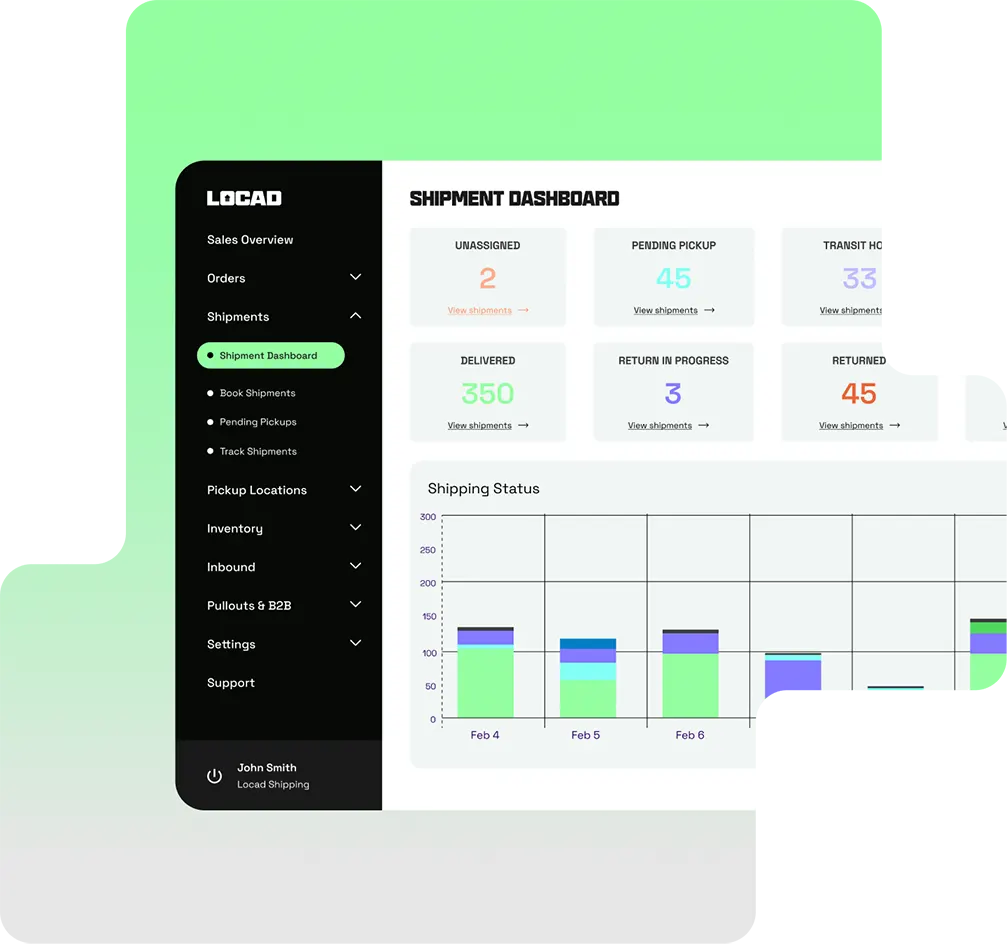
Unified receiving and shipping controls, powered by the Locad Logistics Engine
Real-time inventory sync, exception-aware workflows, and carrier optimisation across every node in the network.
Powered by world-class partners







Frequently Asked Questions
Locad services that back shipping receiving software
Get a fulfillment-led shipping receiving software evaluation
A practical walkthrough of where Locad fits your operating model and where it does not. No vendor-deck theatre.